




Theoretical Hadron Physics Group
Theoretical Hadron Physics Group
Componenti
- Boglione Mariaelena (Coordinatore/Coordinatrice)
- Gonzalez Hernandez Jose Osvaldo (Ricercatore/Ricercatrice)
- Nocera Emanuele Roberto (Ricercatore/Ricercatrice)
- Signori Andrea (Ricercatore/Ricercatrice)
- Flore Carlo (PostDoc)
- Sharma Tanishq (Dottorando/a)
- Yushkevych Tetiana (Dottorando/a)
Contatti
Settore ERC
Attività
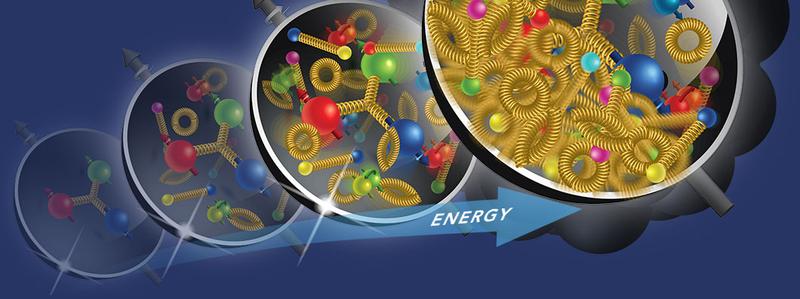
The field theory that describes the strong force is called Quantum Chromodynamics (QCD). It is the mathematical tool that allows us to understand the emergence of matter from quarks and gluons, the elementary degrees of freedom of the theory.
There are several research directions that address a combination of theoretical aspects of QCD, the interpretation of experimental data collected by high-energy and nuclear physics facilities, and advanced computing techniques.
Our group has strong ties with several institutions around the world, for example Jefferson Lab, CERN, DESY.
Progetti
- ProtoTaste - Tasting the flavor of the proton in its full dimensions
- Funzioni di distribuzione partoniche e di frammentazione per scoperte ai collisori di prossima generazione
- Tools for understanding semi-inclusive deep-inelastic scattering measurements
- The strong interaction at the frontier of knowledge: fundamental research and applications
- STRONG 2020 - TMDNext - WP22_JRA4 3D Structure of the nucleon in momentum space
- Improving TMD factorization for the next generation of hadron physics experiments
Prodotti della ricerca
New tool for kinematic regime estimation in semi-inclusive deep-inelastic scattering
Boglione, M.; Diefenthaler, M.; Dolan, S.; Gamberg, L.; Melnitchouk, W.; Pitonyak, D.; Prokudin, A.; Sato, N.; Scalyer, Z. https://iris.unito.it/handle/2318/1856135
Kinematic regions in the e+e− → hX factorized cross section in a 2-jet topology with thrust
Boglione, M.; Simonelli, A. https://iris.unito.it/handle/2318/1838310
Transverse momentum dependent fragmentation functions from recent BELLE data
M. Boglione; J.O. Gonzalez-Hernandez; A. Simonelli https://iris.unito.it/handle/2318/1879290
Factorization of the e+e- ---> H X cross section, differential in z_h, P_T and thrust, in the 2-jet limit
M. Boglione; A. Simonelli https://iris.unito.it/handle/2318/1772376
Universality-breaking effects in e+e- hadronic production processes
Boglione, M.; Simonelli, A. https://iris.unito.it/handle/2318/1770388
Reweighting the Sivers function with jet data from STAR
Boglione, M.; D'Alesio, U.; Flore, C.; Gonzalez-Hernandez, J.O.; Murgia, F.; Prokudin, A. https://iris.unito.it/handle/2318/1774316
Mapping the kinematical regimes of semi-inclusive deep inelastic scattering
Boglione, M.; Dotson, A.; Gamberg, L.; Gordon, S.; Gonzalez-Hernandez, J.O.; Prokudin, A.; Rogers, T.C.; Sato, N. https://iris.unito.it/handle/2318/1714211
Assessing signals of TMD physics in SIDIS azimuthal asymmetries and in the extraction of the Sivers function
Boglione, M.; D’Alesio, U.; Flore, C.; Gonzalez-Hernandez, J.O. https://iris.unito.it/handle/2318/1672369
Kinematics of current region fragmentation in semi-inclusive deeply inelastic scattering
Boglione, M; Collins, J.; Gamberg, L.; Gonzalez-Hernandez, J.O.; Rogers, T.C.; Sato, N. https://iris.unito.it/handle/2318/1630929
Transverse parton momenta in single inclusive hadron production in e + e − annihilation processes
Boglione, M.; Gonzalez-Hernandez, J.O.; Taghavi, R. https://iris.unito.it/handle/2318/1642959
Basics of factorization in a scalar Yukawa field theory
2023-01-01 F. Aslan; L. Gamberg; J. O. Gonzalez-Hernandez; T. Rainaldi; T. C. Rogers https://iris.unito.it/handle/2318/1914370
Resolution to the problem of consistent large transverse momentum in TMDs
2023-01-01 J. O. Gonzalez-Hernandez; T. Rainaldi; T. C. Rogers https://iris.unito.it/handle/2318/1914390
Combining nonperturbative transverse momentum dependence with TMD evolution
2022-01-01 Jose Osvaldo Gonzalez-Hernandez; T. C. Rogers; N. Sato https://iris.unito.it/handle/2318/1888990
ion and kaon fragmentation functions at next-to-next-to-leading order
2022-01-01 Rabah Abdul Khalek; Valerio Bertone; Alice Khoudli; Emanuele R. Nocera https://iris.unito.it/handle/2318/1889554
Parton distributions and new physics searches: the Drell-Yan forward-backward asymmetry as a case study
2022-01-01 Richard D. Ball; Alessandro Candido; Stefano Forte; Felix Hekhorn; Emanuele R. Nocera; Juan Rojo; Christopher Schwan https://iris.unito.it/handle/2318/1889553
The path to proton structure at 1% accuracy: NNPDF Collaboration
2022-01-01 Richard D. Ball, Stefano Carrazza, Juan Cruz-Martinez , Luigi Del Debbio, Stefano Forte , https://iris.unito.it/handle/2318/1889400
nNNPDF3.0: evidence for a modified partonic structure in heavy nuclei
2022-01-01 Rabah Abdul Khalek, Rhorry Gauld, Tommaso Giani, Emanuele R. Nocera, https://iris.unito.it/handle/2318/1889396
Regularising experimental correlations in LHC data: theory and application to a global analysis of parton distributions
2022-01-01 Zahari Kassabov; Emanuele R. Nocera; Michael Wilson https://iris.unito.it/handle/2318/1889552
Determination of unpolarized pion fragmentation functions using semi-inclusive deep-inelastic-scattering data
2021-01-01 Rabah Abdul Khalek ,Valerio Bertone , Emanuele Roberto Nocera https://iris.unito.it/handle/2318/1889392
An open-source machine learning framework for global analyses of parton distributions
2021-01-01 Richard D. Ball, Stefano Carrazza, Juan Cruz-Martinez, Luigi Del Debbio, Stefano Forte, Tommaso Giani, https://iris.unito.it/handle/2318/1889401
Unpolarized transverse momentum distributions from a global fit of Drell-Yan and semi-inclusive deep-inelastic scattering data
2022-01-01 Alessandro Bacchetta; Valerio Bertone; Chiara Bissolotti; Giuseppe Bozzi; Matteo Cerutti; Fulvio Piacenza; Marco Radici; Andrea Signori https://iris.unito.it/handle/2318/1894313
On the connection between quark propagation and hadronization
2020-01-01 Accardi A.; Signori A. https://iris.unito.it/handle/2318/1869447
Predictive power of transverse-momentum-dependent distributions
2020-01-01 Grewal, M; Kang, ZB; Qiu, JW; Signori, A https://iris.unito.it/handle/2318/1869421
A full list of publication is available here